Round, teardrop or diamond? How to choose your first padel racket without wasting your money
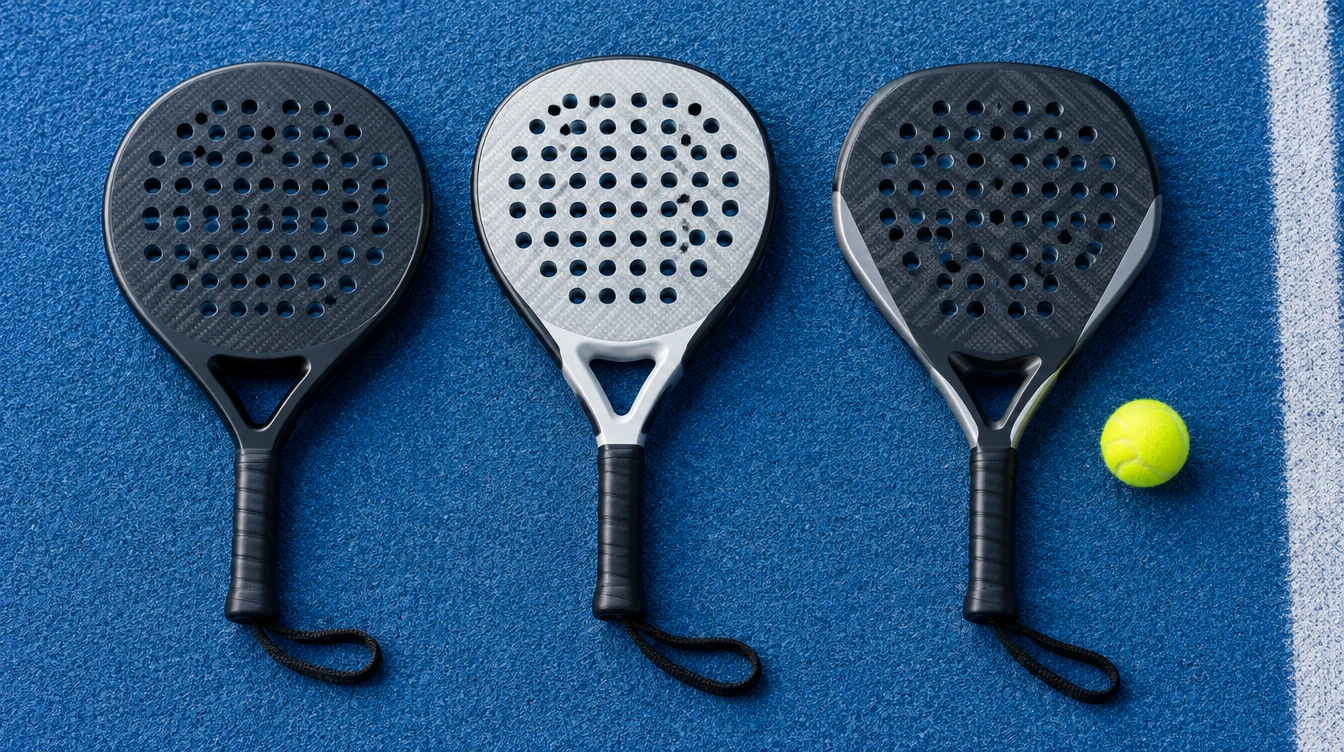
Walk into any padel shop and you will see dozens of rackets that look almost identical: same size, same perforated face, same foam core. Yet two rackets at the same price can feel completely different in your hand. The good news is that only five characteristics really matter, and once you understand them, choosing becomes simple. This guide walks you through each one, based on the rackets we have tested at Padel-Raquette.
The rules set the frame
Every padel racket plays within the same limits. Under the International Padel Federation (FIP) rules, a racket may measure at most 45.5 cm long, 26 cm wide and 38 mm thick, and it has no strings: the hitting surface is a solid, perforated face. That is why the differences between models come down to shape, weight distribution and materials, not size. Our (French) page on official equipment covers the regulations in detail.
1. Shape: the most important choice
The head shape decides where the sweet spot sits, and therefore how forgiving the racket is.
- Round: the sweet spot is large and close to the handle. Off-centre hits still go where you want. This is the control shape, and the natural choice for beginners and defensive players.
- Teardrop: a compromise. The sweet spot sits a little higher, adding some power without losing too much tolerance. A good shape for improving players who are starting to attack at the net.
- Diamond: the sweet spot is high and small. It rewards a powerful, well-timed smash, but punishes mis-hits. It is the shape many professionals use, and a frequent trap for beginners.
We compare the three shapes side by side, with tested examples, in our guide round vs teardrop vs diamond.
2. Balance: where the weight sits
Balance is closely linked to shape. A low balance (weight towards the handle) makes the racket easy to manoeuvre and reduces strain on the arm. A high balance (weight towards the head) adds momentum to overheads, at the cost of handling speed and more stress on the elbow and shoulder. Round rackets are usually low-balanced, diamonds head-heavy.
3. Weight: 355 to 365 g is the sweet zone
Most adult rackets weigh between 340 and 380 g. For a first racket, around 360 g is a safe bet: heavy enough to be stable on impact, light enough not to tire your arm during a 90-minute session. Every beginner racket we have tested sits right there. Players with a history of elbow problems can go slightly lighter. The interplay between weight and balance is explained in our guide weight and balance.
4. Core: soft for comfort, hard for control at speed
Inside the frame sits a core of rubber foam, usually EVA (in soft or hard versions) or a softer foam. A soft core gives the ball more exit speed on slow shots and absorbs vibrations: ideal when you are learning. A hard core only gives its best when you swing fast, and offers more precision on powerful shots. Start soft.
5. Face: fibreglass or carbon
Fibreglass faces are more flexible and forgiving, and help the ball come off the racket easily. Carbon faces (3K, 12K, 18K and so on) are stiffer and lighter, giving more control and power to players with good technique, but a harsher feel. A textured, rough surface helps generate spin, useful later for shots like the víbora and the bandeja.
Our recommendation for a first racket
If you are just starting out, look for a round, low-balanced racket with a soft core, around 360 g. Models like the Bullpadel Flow 2026, the Head Evo Sanyo 2026 or the Dunlop FX Start 2026 (a gentle teardrop) all fit that brief. See the full list on our beginner rackets page, or our shortlist of the five best rackets for beginners.
Once you play twice a week and your technique is settling, it is time to think about a teardrop or a hybrid shape. If you hesitate between two models, our racket comparison tool puts their specs side by side, and our price and budget guide helps you avoid paying for performance you will not use yet.
Padel-Raquette is a French-language site: the guides and tests linked above are in French, but the spec tables speak for themselves.